Showing posts with label issues in fandom. Show all posts

Saturday, April 24, 2021

Video: Is Star Trek Communist? (Short Answer? No.)

For what it's worth, I do believe the intent behind Trek is secular-humanist and progressive at the very least; we're not exactly lacking when it comes to first-person sources on this subject. But in execution, the show speaks to universal values that fans across the political spectrum can appreciate -- and DS9 in particular often gives alternate points of view a voice because its writers were talented and just couldn't help but craft nuanced stories with multiple layers.

For more of my thoughts on the political orientation and appeal of Star Trek, check out the post here.

Saturday, April 17, 2021

From Last Year: Politics in Comics

(4/17 Note: Resurrecting this post because folks are still writing politicized trash.)

I'm sure you've heard this one a million times before: "Comics have always been political. Don't you remember that time Captain America punched Hitler in the face?"

The latest purveyor of this canard is Kurt Busiek, who took to Twitter this week to lecture #Comicsgaters for our supposed failure to understand this fact. But bruh -- as much as I loved your 1998 runs on Iron Man and the Avengers, you're revealing your ignorance about our true position.

No one is actually saying comics should be completely apolitical. First of all, that's impossible. We can't help but inject our worldviews into our creative work. Secondly, that would be boring. The reason why we human beings get exercised over politics is that we're fighting over things that actually matter. And stories? Yes, they need to talk about things that matter -- which means, at times, they need to address politics.

But there are good ways and bad ways to incorporate politics into comics -- and here's where we get to the meat of what #Comicgaters are really saying. When we bitch about Current Year comics being "too political," we are are complaining about the following:
  • an excessive reliance on political themes.
  • a lack of subtlety in addressing those themes.
  • a boring uniformity of perspective.
  • the warping of established characters to serve political ends.
Let's discuss each of these in turn.

An excessive reliance on political themes.

Comics in earlier eras sometimes got political. But most of the time, our heroes battled archetypes -- such as the lowlife thug or the megalomaniac with ambitions to dominate the world. Tony Stark, Light of My Life - just to pick one example - was most often pitted against organized crime, unscrupulous business competitors, and - oh, yes - a dude wielding ten alien rings. And that's when he wasn't battling his own psychological maladies! Indeed, the very best Iron Man comic in history, in my view, is one in which the only villain is Tony's own alcoholism.

Today, however, creators seem hell bent on injecting their political views into everything. As I observe in a video I uploaded to YouTube yesterday (which will be linked here in this Sunday's post), this very tendency is what ruins last week's Rescue 2020. What could've been a fascinating reflection on the feasibility of scientific resurrection is disrupted by annoying, off-topic feminist twaddle. And this is not an isolated case. This kind of storytelling failure can now be found everywhere.

A lack of subtlety in addressing political themes.

Sometimes, earlier comics would be on the nose -- particularly during wartime when the demand for patriotic propaganda was high. But be honest: are those the comics that truly endured? Or are they just looked upon as amusing historical curiosities -- or as convenient examples to deploy when you want to justify your own bad writing?

No: comics that last universalize. The X-Men absolutely were an allegory for the marginalized. But that's the point: they were an allegory. They allowed writers in earlier eras to tackle themes of prejudice and discrimination from a timeless distance. The upside to this approach? Those comics don't have an expiration date. They're always accessible.

Writers these days, on the other hand, seem to have no patience for subterfuge. Instead, they slap you right across the face with their so-called "resistance." Thus, their comics are both dated and extremely parochial. Like the Hitler-punching comics of World War II, they will not be endlessly re-read.

A boring uniformity of perspective.

Yes: the comics industry has always had a leftward lean. But in earlier eras, there was still an observable diversity of thought among writers and artists. Steve Ditko, the Objectivist, was allowed a place at the table. And more recently, so was Chuck Dixon.

In Current Year, meanwhile, the left is doing everything it can to purge the comics industry of even vaguely contrary voices. Hell: regardless of your own views, if you even so much as talk to a known dissenter, you're now a prime target for cancellation. See also: Blake Northcott, who's being stalked right now by a bitchy comic book Karen who imagines herself to be a legitimate political commissar. The result of campaigns like this? A monoculture. If you work at one or more of the major publishers, you can only be out and proud if you're an adherent of the D.I.E. religion and agree that Orange Man Bad.

And the more strict and picayune the enforcement of the aforementioned monoculture becomes, the more radical - and more predictable - the books become. When political topics are addressed, they're almost always addressed in the exact same way -- to the point that we all make jokes now about the ubiquity of the straight, white male villain; the female character who wuvs da science; or the butch, black lesbian.

For Christ's sake, do something else.

The warping of established characters to serve political ends.

It's fair to say that the comics of earlier eras, for the most part, expressed a broadly liberal worldview. But what did that mean exactly?

Well, for one thing, it meant that Captain America went on record defending free speech for bigots:

Click to embiggen.

It also meant a rejection of retaliatory, supremacist attitudes, as we see here with Machine Man:


The comics of earlier eras were generally pro-Civil Rights, pro-worker, and skeptical of war. Tony Stark - to once again dip into the lore I know the most about - eventually left the weapons business for more idealistic pursuits, was very generous with his employees, and always demanded ethical conduct from his corporate board. But to suggest that you can draw a straight line from this sort of classical progressivism to today's radicals is to pull a fast one. No: SJW writers have more in common with an Iron Man villain like Firebrand - the guy who wanted to start riots and tear down the system - than with the legacy heroes.

And because a bunch of Firebrands are now in charge of the comics sold in the direct market, said legacy heroes? They're being absolutely butchered. The most recent simulacrum of Tony Stark is dead now (sorry about that spoiler), but before his demise, he was leading a terrorist movement. Steve Rogers has been deconstructed and consequently robbed of his agency. She Hulk has apparently become a violent feminist vigilante. The X-Men are now segregationist mutant supremacists. Need I go on?

TL;DR: There's no continuity between early canon and the present. On the contrary, there's been a fundamental rupture.

Conclusion:

To be sure, none of the above commentary is meant to suggest that there are no readable comics coming out of the mainstream industry. There are -- but they're getting increasingly harder to find amongst all the dreck. And yes: we contend this is because comics have become "too political" in all the ways described in this post.

If you're going to argue against this charge, at least take the time to accurately comprehend what we mean.

Saturday, April 10, 2021

Hail Lobster!

"Clean your room." - Adolph Hitler (Supposedly)


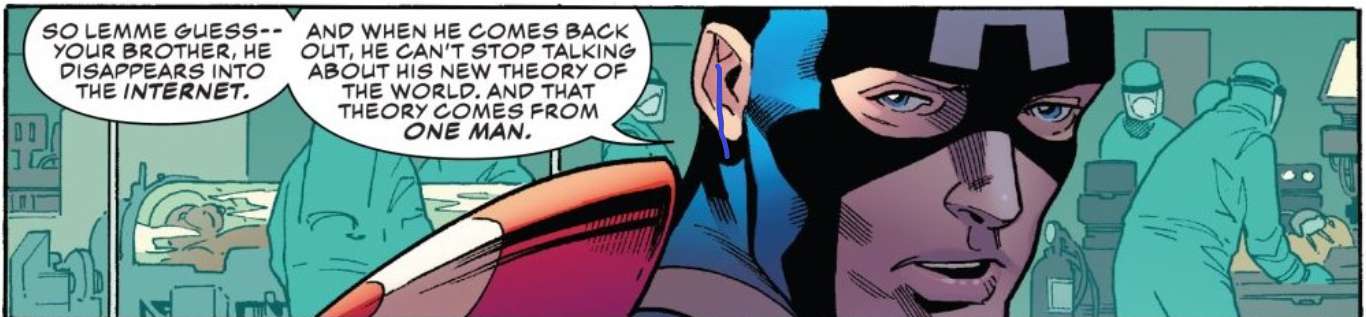
Many other people have been rightfully mocking Ta Nehisi Coates' latest issue of Captain America for its risible - and not at all camouflaged - take on Jordan Peterson (including Peterson himself). But I'm going to jump in too in the hopes that, at the very least, some of my remarks will entertain my regular readers (and any newcomers who happen by).

Coates can write opinion pieces with some felicity of expression. But he is neither a deep thinker nor - more importantly for the subject of this post - a good storyteller. A good storyteller approaches the world and the people in it with a fundamental humility and a desire to understand. He realizes that his subjects are complex (because they are human subjects), seeks to dig up and display the contradictions and oddities that make his individual characters who they are, and leaves himself open to surprise. He doesn't regard our earthly existence with the airs of a know-it-all. And if he has a message, he certainly doesn't insult the reader's intelligence by stacking the deck in his own favor or by making his designs so blindingly and obtrusively clear that no thinking (on the part of the reader) is necessary.

The best Marvel comics of earlier eras were written by good storytellers. Said creators dreamed up disabled heroes like Iron Man (in his earliest iteration) and Daredevil -- and then proceeded to think about their likes & dislikes/their foibles/their deepest desires/etc. instead of seeking congratulations for being "inclusive." Moreover, they tackled real-world issues with at least some subtlety. Yes, older X-Men comics did highlight the evils of prejudice -- but they did so with universal depictions that the marginalized of all stripes could recognize and appreciate. (For more of my commentary on the "political" comics of yesteryear, please see this post in particular.)

Coates, on the other hand, doesn't have the talent - or the desire either, probably - required to craft an ingenious, suggestive allegory. Instead, he smacks us in the face with his opinions in the clumsiest way possible, thereby leaving himself open to deserved criticism:  


So let's beat this down, shall we?

1. Steve didn't embrace service to his country because he was weak and looking for purpose. His desire to enlist was a function of his greatest strength: his steadfast morality. Yes, he was shrimpy before the serum, but that had no bearing on his motivations. He's Captain America because he recognized evil and cruelty in the world and desperately wanted to confront it head on. And actually, if you really think about it, the whole story of Steve's transformation and proceeding commitment to upholding liberal values in every corner of the world is pretty damned Petersonian. Steve had to become dangerous (i.e. take the serum) before he was fit to do good.

2. "He tells them what they've always longed to hear. That they're secretly great." No: Peterson says the opposite -- repeatedly. Though he believes that each person has a capacity for greatness, he also stresses - in all of his books - that each person has a coequal capacity for malevolence that must be acknowledged and controlled. And he further argues that such dueling with the Adversary (a.k.a. our evil inclinations) is a laborious and often painful endeavor. Peterson, in short, doesn't puff people up with phony praise; to be heroic in the Petersonian frame is to work towards genuine goodness and competence.

3. "That the whole world is against them. That if they're truly men, they'll fight back." No: Peterson says the world is against everybody -- in the sense that life for every human being is unavoidably difficult and tragic. And then, crucially, he adds that our response to this misery should not be resentment but gratitude for what we do have and a firm determination to better our own little corners of the cosmos by focused work on our own flaws. He would absolutely condemn Red Skull's followers for indulging in their anger and sowing mayhem.

4. If I recall correctly (it's been a while since I've read Maps of Meaning), Peterson originally became interested in archetypes and stories because he was horrified by the evils of Nazism and Communism and wanted to explore the mental architecture that led to Auschwitz-Birkenau, the Holodomor, and other such atrocities. As he tells it, confronting those 20th century horrors disturbed him so profoundly that he decided to embark on a life-long project to examine and comprehend them. So: maybe you think all that talk about rescuing our fathers from the underworld is weird. Maybe you take issue with his use of Jung and Nietzsche. Maybe you think he's wrong when it comes to feminism or novel pronouns or other controversial issues. Or maybe you simply think his Kermit voice is annoying. Whatever: I'm not some starry-eyed idol-worshipper who thinks no one has a right to dislike the man. But to insinuate that Peterson's thought has anything in common with the Nazi ideology of the Red Skull is to utterly invert his intentions. He pleads constantly for moderation and balance and decries extremism on the left and the right (though his criticisms of the radical left are more visible because, quite frankly, it's the left that's presented the biggest threat to our liberal order in recent years).

In sum, what the incurious Coates has done here - besides revealing his utter inability to write a story worth reading or to grok Cap's essence (see point 1) - is attack Straw Peterson and his purple-monkey-dishwasher remarks.* (Straw Peterson may be even more diabolical than Straw Larry Correia, International Lord of Hate. Damn that monster!) Oh: and he's engaging in IMAX levels of projection too -- because what is his leftist ideology but a worldview that insists the entire world's arrayed against you (if your "identity" puts you near the top of the progressive stack) and that you should rise up and overturn the "system" that keeps you down? Peterson has actually helped people**; it's critical social justice that's a refuge for the weak and incompetent. It's critical social justice that's stoking the lion's share of our present-day hate.

But here's the good news: at least the memes are fire -- and so is the merch. Hail Lobster, indeed! 


**The most appalling thing about Peterson's detractors is their open disgust that Peterson would dare care about men or seek to inspire them. (He actually cares about human beings in general and has inspired people of all genders -- but that's neither here nor there.) How heartless and depraved must these people be that they 1.) deny that men could ever have challenges deserving of our sympathy and 2.) howl down anyone who looks at a guy in trouble and decides to lift him up?  It just goes to show that Peterson's right about ideology at the very least: it really does twist your soul.  

Saturday, March 27, 2021

Handling Racism in Comics

One better-than-average modern example -- and one that is execrably bad.

The "representation" crusade that has taken over the mainstream comic book industry is, in my view, a blundering, incompetent attempt to "fix" a "problem" that wasn't especially pressing (and probably would've resolved itself organically given enough time if publishers continued to hire people on merit). Strong non-majority heroes have existed for decades -- and they've existed in enormously popular books (like the X-Men series) at that. If anything, what today's writers and artists have done is strip said non-majority characters of their dimension by excessively hammering present-day politics and forgetting about the fun. Got a comic featuring a black character? Inevitably, it has to bring up police brutality and Black Lives Matter. Got a comic featuring a Hispanic character? Nine times out of ten, it'll be about illegal immigration. Got a comic featuring a LGBT+ character? Well, is he/she/they even queer if it isn't mentioned in some awkward and ham-fisted way? It's boring and predictable, this relentless no-escapism, and in many cases, it trashes the visions of these characters' original creators, who sought to create inspiring and complex role-models for their diverse audience.

Once upon a time, characters like Nubia, Static, and T'Challa were written as intelligent, powerful, and emotionally rich. They weren't forced to serve as constant avatars of racial grievance. (Click to embiggen.)

Now, having said all that, I do think it's possible to, every once in a while, write an okay - or even good - comic that tackles a controversial social issue. As a matter of fact, I read just such a book earlier this week: Superman Smashes the Klan, an all-ages graphic novel by Gene Leun Yang and Gurihiru. 

The message of Superman Smashes the Klan is not especially subtle -- but unlike most other books in its niche, it avoids Manichaean demonization - or sacralization - of entire subgroups of people in favor of treating its characters as individuals. Roberta, the lead, resents the pressure she feels to assimilate -- but her older brother Tommy is more easy-going and willing to joke about his Chinese heritage, and her father (also eager to fit in) repeatedly demands her mother refrain from speaking her native Cantonese. I strongly suspect the author favors Roberta's point of view -- yet at no point are Tommy and Dr. Lee portrayed as anything but sympathetic. In other words, Yang reveals that Chinese-American views on assimilation are not monolithic, and he does so without unfairly vilifying approaches with which he does not agree. 

"But what about Yang's white characters?" you may ask next. Well, they too vary in their beliefs. The clergymen who founded the Unity House are clearly racially progressive, and the white kids who hang out there are also well-meaning (if occasionally insensitive). And then you have Chuck; his family members are mixed up in the activities of the local Klan, but even he is depicted as a confused, misguided boy who fundamentally wants to do the right thing. The upshot? Yes, there are over-the-top Klansmen here, but they are definitely outnumbered by the white characters who are principled, moral, and/or capable of redeeming themselves. 

In every way, Superman Smashes the Klan outclasses the recently released Nubia: Real One, another graphic novel targeted to young audiences that attempts to address racism in the US. Yang's work allows for layers and nuance; L.L. McKinney's hateful book, on the other hand, does not. 

In Nubia: Real One, every white character is racist and evil -- and every black character is a saintly victim. According to McKinney, white society would largely reject a young black woman with superhuman abilities -- even though, once again, Storm (just to take one example) has been a central X-Man since Claremont (who, by the way, is white -- as was Jack Kirby, who created T'Challa). According to McKinney, BLM-associated riots are the fault of white outside agitators -- even though plenty of real-world cases demonstrate that this is not wholly the truth. According to McKinney, a black girl would obviously be blamed for a convenience store robbery regardless of the surveillance footage or the many witnesses who could provide evidence in her defense -- a contention even black reviewers have challenged as patently ridiculous. According to McKinney, there's nothing a black girl needs to do to develop herself and become a better person -- even though wise people would say that self-improvement is an obligation for every human being.

Advice like this is bound to breed terrible people who are simultaneously helpless and narcissistic. Even if you are "oppressed," you still have moral responsibilities. Victimhood does not make you infallible, and rejecting personal responsibility until the entire world has been perfected in your eyes is unconscionably lazy. By all means, agitate for justice where it's needed and achievable -- but in the end, God helps those who help themselves. (Click to embiggen.)

In short, Nubia: Real One insults the reader's intelligence with flat caricatures and nonsense premises that fail the test of verisimilitude, whereas Superman Smashes the Klan gives us, for the most part, actual human beings. Moreover, while Superman Smashes the Klan is blessed with visually appealing art, Nubia: Real One assaults our eyes with atrocious Tumblr-style drawings that make Diana Prince look like a pug-nosed hag and similarly rob Nubia of her beauty and femininity. No one should be satisfied with such a deliberate destruction of the heroic. The entire point of a superhero comic is to give the reader something to aspire to -- not to wallow in the base and prosaic.

As long as comics like Nubia: Real One continue to be churned out by open racists and segregationists, people will continue to chafe at the idea that we should talk about race in our comic books. It's an infinitely better choice to produce books like Superman Smashes the Klan. It's an infinitely better choice to hire people with actual talent and hold everyone to the same exacting editorial standards. 

Edited to add a related video:

Yeah, I imagine that is how they be. No-escapism infests all media.

Friday, February 26, 2021

Guest Post: Feminist Nonsense in Woke Entertainment, by Moira Greyland Peat

In Hollywood, woke projects abound. Batwoman exists to show us that putting a pretty, capable black actress in the leading role will make us interested in discovering that we are all racists, and that she is perpetually discriminated against. She is described as “wildly undisciplined” as well as being a karate expert, who grew up homeless and now lives in a van down by the river, like that SNL skit.

Furthermore, the notion of a “wildly undisciplined” martial arts expert is simply ridiculous. It would be like a clumsy Jedi master, who constantly dropped his lightsaber, whacking off random body parts as he did.

The writing makes the show absurd. It is not Javicia Leslie’s fault that the scripts are so bad. They are not meant to tell us stories, but to “educate” us.
Instead of writing a story about an INTERESTING black lesbian, they’ve written a story about a woman who is black, a victim, and a lesbian, and has no other characteristics whatsoever. The actress is stuck with a non-character to play, and her potential is wasted.

Similarly, in Star Trek Discovery, Sonequa Martin-Green, who was dynamite in The Walking Dead, is meant to play the part of a walking diversity lecture. If her character had been written to be an interesting human being, the show would have topped the charts. But since it is all about diversity, rather than all about PEOPLE, the show falls flat and has been propped up and propped up.

Sonequa Martin-Green’s character Michael Burnham is unfeminine, somewhat amoral, willing to commit murder when enraged, and her defining characteristic is being AMAAAAAZING. She can do amazing things just because, and is smarter than everyone. She also taught Spock to spock, because apparently his absolutely adequate father mysteriously didn’t teach him with every word and every breath, nor did Spock’s comprehensive education on Vulcan manage to do that. Nope, a few lectures from the amaaaazing Michael Burnham was all it took.

This kind of lazy, foolish writing is becoming a bad habit. Dr. Who, a show which had enjoyed popularity and legendary status for over fifty years, is floundering with the female Dr. Who. Once more, the stories are not about PEOPLE. They are environmental lectures, diversity lectures, and representation lectures, and Dr. Who’s only feminine characteristic is the ability to NAG.

Dr. Who #13, the woman, is sexually ambiguous, has a non-gendered costume which would be absurd on any human being, and she lacks both heroism and character. The show is more about her being female, while lacking any trace of femininity, and less about what she actually DOES.

Most recently, the graphic novels of The High Republic have had an embarrassing start. Despite money poured into their creation, for example strings being pulled to obtain a New York Times bestseller ranking for a book very few people have seen, let alone read, the books are failing. The characters are placeholders to drain the dirty sinkful of representation into.
The parts I have seen do not interest me, because the stories as well as the characters are a big nothing. No purpose, no need to accomplish a goal, no war, little to no conflict, and the primary characteristics of the female characters is to be amazing, and to admire one another. For what? Unclear. The male characters are either fat, or gay, and they are sidelined in favor of the much more important teenaged girls, amazing for some unclear reason.

The defining characteristic of a leading man or woman is heroism. They might look at Ahsoka Tano in The Clone Wars for a cartoon character that is both heroic and fallible, even vulnerable. Heroism means moral virtue, a purpose, and the willingness to sacrifice oneself in the service of something greater.

It has nothing to do with navel-gazing about how “strong in the force” some witless teenager allegedly is! What have they actually DONE?

Firing the writers would be a good start.

Why is the writing on these shows so bad? Could it be that with the focus on the “voices” of people in alternative communities that absolutely anything they come up with is allowed to stand exactly as is?

That in itself belies bigotry, because any “normal” writer would be subjected to many edits and challenges, so the story would be the best it could possibly be. Seeking out writers as checkboxes rather than writers offends the profession. There are plenty of excellent writers of every diverse brand who have become famous for their competence, not for their diversity!

One important issue is the set of assumptions that the writers are saddled with. To begin with, rather than writing stories about people acting like people, the characters are tasked with acting the way that the writers have decided they should, in order to influence our own reactions.

Let us draw a contrast with the “strong female characters” of the previous era. Janeway from Star Trek Voyager was strong, and female, but she remained female. She put on strength to make her crew feel confident in her leadership, but she retained her femininity and her desires for pairbonding and love, even though they could not really be realized in her situation.

One splendid example of this was when she fell in love with a alien who had been trying for some time to find contraband cargo on her ship. He pretended convincingly to defect from his regime, and found out the realities of life on her ship. But when he went back to his regime, hoping to use the information he had found, Janeway had outsmarted him, and he only managed to embarrass himself by claiming he had found contraband, where the containers contained only vegetables.

Yes, she fell in love. Yes, she let the man find out too much. But she also kept her wits about her and put the safety of her crew above her own heart, and it was delightful to see the dastardly alien beaten at his own game.

The assumptions behind Janeway were that although she was strong, she was human, that is, fallible, and still she was female.

In the case of so many other characters written today, the assumptions are that they are infallible, and their femininity is given up in favor of being more sexless.
Their “strength” is invariably physical, and thus unbelievable. Why would a woman who weighs 105 lbs be able to beat a pack of 200 lb stuntmen who could literally break her in half? Why not write these women a way to handle physical conflict which does not require a direct contest to strength?

Worse, their emotional strength is written as being invulnerable, tough, and rigid, lacking any trace of femininity. The only feeling regularly expressed is anger, expressed in an overt masculine style, rather than in a range of more feminine styles, such as snarky humor, cutting remarks, or sidelong putdowns.

No, once again, the women of today are written to eschew any sign of actual feminine characteristics. It is almost as though the real assumption is that being female is bad, and the only way to be an acceptable female is to be as male as humanly possibly, while remaining physically female.

Of course, for some writers today, even looking physically female is too much. Breasts must be reduced or eliminated, lest men actually be attracted to the women who have them. The “male gaze” is not only normal, but universal, and yet women are still supposed to not look like women, or react to men like a woman would, with attention, physical responses, and even, perhaps, interest.

No. Women in major TV and movies today are meant to be as mannish as possible, and that means they do not want relationships with men. Several major female stars, like Batwoman, are supposed to desire women only, and to have promiscuous, visible sexual encounters with them.

We are meant not only to accept that huge numbers of lesbians exist everywhere, as though there were more lesbians than straight women, but we are also meant to admire, and if possible, to emulate them. We are meant to accept that defeminzed women are normal, and straight relationships are either abnormal or unhealthy, and that strong women, by and large, do not breed. Or marry. Or have relationships with men.

Worst of all, if we have relationships with men, they are either submissive men, like Book and Michael Burnham, who in reality are quite intolerable for strong women, or maniacs, like Kylo Ren and Rey, who kissed once before he died... because she killed him.

In my own background, as the daughter of Marion Zimmer Bradley, a famous feminist lesbian author, I knew that she thought that the guy should not ever “get the girl” at the end of the story, and instead of having a pairbond, women were supposed to walk off into the sunset to go get self-actualized or some nonsense like that.

She brought me up to believe that my desire to marry and to have a family was awful, a failure, and in reality I should be a lesbian, placing my Great Purpose above all else.

I see this reflected in so many of the currently fashionable, failing TV shows and movies.
Women are not allowed to be women, and naturally, men are not allowed to be men. Any show of masculine strength and protectiveness has to be twisted into being a crime, and never interpreted or displayed properly.

Men themselves must be prepared to either be gay or to have no pairbond at all, and either to be a limp, sexless sidekick to a “strong woman” or a villain.

The question I am left with is “WHY?”

Where writers and showrunners natter on about representation and diversity, actual women, who make up most of the female half of the human race, find nobody to identify with. Sure, the character might be female, but they don’t act female. The character might be a lesbian, but how many lesbians are so masculinized that they are overtly promiscuous? The character might be black, but they are never allowed to be beautiful or feminine. How can a woman identify with someone who is nothing like who she is or what she wants to be?

For those of us who actually are strong women, even with a warlike background as I had (fencing champion, socialized to be masculine) there is one shining example of a woman we can really identify with: Cara Dune from The Mandalorian. She was strong, gorgeous, not overpowered, sensible, realistically able to grapple with actual men due to her training, and obviously loyal, kind, and yes, feminine under all that armor.

And what happened to her? She was sacked, despite being the most popular character on the show other than Baby Yoda. She was universally loved, by both women and men, and her firing resulted in countless people canceling Disney+, including me.

And still Batwoman is in her show, trying to “inspire” women to quit being women and to become bad imitations of the worst possible men.

Of course, there is a worse possibility. Queen Latifa, hilariously cast as “The Equalizer” is meant to inspire women of *cough* SIZE to believe they can go be action heroes just because.

And what happens when reality just refuses to cooperate?

Friday, February 19, 2021

The Controversy Regarding Baen's Bar: My Response

(ETA: I wholly endorse Larry Correia's open letter. Every. Single. Word.)

BLUF: Looks like somebody is angling for a Hugo Award in the Related Works category

Quite a few folks associated with Baen - including David Weber, Eric Flint, Larry Correia, and Toni Weisskopf - have already responded to this transparent attempt to cancel a significant SFF publisher -- but I'd like to add my $.02 because the cherry-picking, the hypocrisy, the ideologically-induced reading comprehension failures, and the princess-and-the-pea prissiness of this guy's post are all deeply offensive and should be called out as often and by as many people as possible.

Let's take each claim in turn.

Major Claim #1: "Baen’s Bar has also become well-known in the genre community as a place where racism, sexism, homophobia and general fascism continually pop up."

The link provided in this sentence takes us to a forum thread on another website in which the transgender originator shares screen caps of people in Tom Kratman's conference being rude to her. Now, I'm no fan of rudeness as a general rule, but there are a couple of things I notice about this link:

  1. It's from 2014. If this behavior were a persistent and wide-spread problem on the Bar, surely more recent evidence would've been provided.
  2. The complainant at the link self-servingly elides her own contributions to the flame war while insisting that she's been perfectly reasonable the whole time and that the response of the folks in this conference is an over-the-top and bigoted reaction to what she said. Yeah, sure. Because the Bar is down, I can't search for the entire argument. However, the Barflies I know don't pop off like that for absolutely no reason.   

Now to zoom out a little bit: When a leftist claims that something is -ist, my first instinct is not to believe it. And, I think, I have a very good reason to initially approach such assertions with skepticism. As we all know, bourgie progressives like the writer of the above "exposé" (and the individual whose negative run-in with the Kratskeller he's using as an example) are absolutely obsessed with how we all talk to each other. But in my personal view, policing our words is often a way to look like you're doing good while actually unconscionably imposing upon other people's freedom and peacocking about your superior social status. 

The pronoun thing, for instance, definitely falls into this category. I will use people's pronouns if I know them. But it should be said that pronouns are only used when you're talking about someone -- so demanding that we use your preferred pronouns is in fact demanding control over how we talk about you beyond your earshot. Who gave you the right to expect total acquiescence to your preferences at all times and in all places from people who most likely have no personal relationship with you whatsoever? Further, people who aren't from one particular rarefied class in our society don't really understand radical gender ideology (because it's mostly nonsense if we're being perfectly frank) and find the singular "they" (or the ever expanding slate of invented pronouns) confusing -- so taking people to task for resisting pronoun edicts is, in many cases, taking people to task for being poorer and less "educated" than you are. (And I put "educated" in scare quotes here because a sheepskin is no longer a reliable signal that you are genuinely learned. I've got one of those things - and from a pretty prestigious public Ivy too - but I don't even think I'm truly educated. And I've been trying to fix that for my entire adult life.)

From what I've observed in my own interactions with the Barflies, a lot of the people who are active on the Bar come from working class and/or military backgrounds; in said milieus, rough discourse is a way of life. Indeed, as a military brat myself, I have personally witnessed how our servicemen routinely roast each other using epithets that would absolutely get a lefty upper-middle-class fella's ears all a-smokin'. At the same time, I have also witnessed how well people handle racial and cultural differences in the very same military contexts. A group of diverse Marines may toss no-no words around like they're candy, but fundamentally, respect reigns among them regardless of race.

Mind you, I'm not trying to say that the people in Kratman's conference at that link were somehow being respectful in a different way. They weren't. Nor am I trying to say that we should just drop all concern about the language people use. We shouldn't. But I still think it's worth pointing out that different classes in our society have different communication styles because it speaks to the shallowness of the left's linguistically-focused approach to justice. Judging people solely by their adherence - or lack of adherence - to the exquisitely sensitive standards of speech of the progressive Brahmandarins is a piss-poor way to find real racists/sexists/homophobes/etc. You have to look deeper. You have to consider action, intent and context. And that brings me to...

Sub-Claim #1a: "For example, a Baen’s Bar user from India was nicknamed “The Swarthy Menace” on the forum by author Tom Kratman. People on the forum thought that was the height of clever humor."

This is what I mean when I say this take-down of the Bar is prissy. The user in question was a willing participant in this particular joke. "The Swarthy Menace" has the same exact energy as "White Mormon Men with Fantastic Racks," which is what we lady-Pups called ourselves in response to false claims that the Sad Puppies were all cishet white men. From the link provided: "This came about due to a left winger from Space Babies claimed Arun was afraid of the Swarthy Menace while debating one of the Colonels books. What made it funny is that Arun is from India." (sic) As you can see, in both cases, the intent was perfectly legitimate: to make fun of people's stupid assumptions. Yet here come the conversation cops to tell all of us that ackchyually, we're being super racist and having fun wrong -- even though literally no one involved was insulted. Mind your own bee's wax, you buttinsky.

Sub-Claim #1b: "Racist comments and innuendos frequently appear in many forum discussions. In a thread last year titled 'Soft Civil War & Trump’s Army,' user Captrandy wrote that political conflicts in the USA could be solved if 'all the angry and non angry white males should stop going to work for a month or so.'"

Okay, let's consider the context in which this was uttered. For the past several years - or more - the commentariat has pushed the idea that white people - especially white men - are the fount of all evil. And in response, the education system, the corporate boardroom, and the government have all consented to the further propagation of this toxic worldview by bankrolling so-called "diversity training" in which whites are singled out solely due to their skin color and subjected to Maoist struggle sessions in which they're forced to confess to crimes they did not commit and to prejudices of which they are not aware.* If you're shocked that this has led to resentment - and to a desire to assert (truthfully, I might add) that white men have contributed and do contribute in a positive way to our nation and the world - then you, cupcake, have zero idea how human beings actually work.**

(*Note: I'm happy to talk to folks about the unique disadvantages certain groups face in this country -- but not if it involves blaming all living white people for circumstances most of them had no hand in generating or holding them responsible for things that might lurk deep inside their ids. Most white people - particularly po' whites - are not all that powerful. And berating people for so-called "unconscious bias" is like throwing people in jail for their dreams. It's ridiculous -- and abusive.) 

(**And now the boogaloo: I think it's a bad idea for white people to develop a "white identity." But if you want to stop that from happening, the last thing you should do is start treating white people as if they're an undifferentiated mass of malefactors. As we can see right now in freakin' real time, all that does is remind white people that, waitaminute, they're white.) 

(And now I think it's time to put a jump on this before this post eats my whole front page...)

Friday, January 22, 2021

My Simple Plan to Fix Our Conventions

Harness the power of NO.

That's it. That's my advice.

For years now, a small but loud group of activist mediocrities has successfully bullied fandom's honest, largely innocent denizens into increasingly abject postures of surrender, and quite frankly, I'm officially sick of watching this toxic, pointless game. Someone somewhere on some convention committee needs to find his or her stones and tell said mediocrities exactly where they can go.

The "social justice" DIE cultists are never going to be satisfied no matter what conventions do. Why? Because the "anti-racist" ideology that animates their activism is designed only to destroy and deconstruct, not to build. It declares with certitude that racism is an omnipresent and ineradicable feature of our society (or, in this case, fandom) -- and then merrily goes off in search of evidence for that conclusion, thereby enshrining confirmation bias as a central virtue. It erroneously declares society (or fandom) a fixed pie, openly calls for retaliatory discrimination to right cosmic wrongs, and consequently encourages different groups to battle each other over who will get the benefits. And it cares not for logic or consistency in its rules-making, embracing double standards that favor some at the expense of others. 

(To get informed on what we're actually dealing with here, please go here. Fandom is being assailed by hardcore quasi-religious totalitarians, not well-meaning progressives. Recognize this and act accordingly.)  

Virtually no one disagrees that diversity in the fandom - defined properly as the inclusion of people with different worldviews from many different walks of life - is a good thing. And virtually no one disagrees that convention attendees, no matter who they are, shouldn't be subjected to hate and/or harassment. What we absolutely must resist, however, are demands that we silence good-faith disagreement and/or jettison merit in favor of preferential treatment. Claims that someone's speech has caused "harm" should not be automatically accepted at face value -- and "I belong to disadvantaged group Y" should not accepted as a sufficient CV for a seat on a panel and/or special recognition. Learn the difference between toxic diversity and real diversity -- then implement the principles of the latter in your convention spaces.

And if, in adhering to genuinely non-racist values such as those outlined in the post linked above, you become a target of the baying "anti-racist" mob, just ignore those attacks. I cannot stress this enough: if some people scream and cry that they don't "feel welcome" because you and your fellow convention volunteers have chosen to act like reasonable, decent, normal human beings and not like crit-theory-addled psychopaths, invite them to voluntarily remove themselves from your event. "This convention is clearly not for you, so feel free to not come." Don't ever apologize for being liberal. As we've seen with World Con, all that does is encourage further abuse.

Edited to add bonus content:

Friday, December 11, 2020

SJB's Are Trying to Kill the Craft of Acting

The #FixMsMarvel hashtag - with which Twitter activists are objecting to the casting of a Christian actress to play a Muslim character (and making other complaints that vary in their legitimacy) - is only the latest manifestation of yet one more "social justice" trend that needs to be called out for its outright nonsense.

No: you do not need to be Muslim to play a Muslim character. You do not need to be disabled to play a disabled character. You do not need to be trans to play a trans character. That's why they call it acting. The entire point of acting is to reach into someone else's experience and then portray it on the screen (or stage). Acting is not the art of being yourself.

This is not to say that Muslim, disabled, or trans actors shouldn't be encouraged to audition for Muslim, disabled, or trans roles. Everyone who's interested in a particular project should get a fair shot. But that's not what the above-mentioned bullies want. Instead, they want certain roles to be reserved for those who are favored in the progressive stack. This will lead to an epidemic of bad acting (just as similarly-motivated campaigns have led to widespread bad writing and bad art) -- not because excellent Muslim, disabled, or trans actors don't exist but because they don't exist in great enough numbers to fulfill the simultaneous demands for more "representation" for these groups.

Hollywood's remit is not to be a guaranteed jobs program for the "marginalized." Hollywood's central mission is to create quality entertainment for the masses. Right now, it's failing in that mission for a whole host of reasons -- chief among them its acquiescence to political pressures that have nothing to do with the cultivation of merit.

If you're an actor from an "under-represented" group and you're using your identity as a cudgel to intimidate your competition into vacating roles you think belong to you -- you are a cheater. I'm sorry, but that's the truth. Even if your dishonorable tactics succeed, you haven't actually earned what a bunch of scared, guilty Hollywood execs have given you -- and everyone will know it

Instead, you should work to get these roles the old-fashioned way: by getting so good (and so confident) that no industry mogul can possibly ignore you. That means taking a bunch of shit jobs to build your skills and your resume -- and making friends, not terrified "allies." It doesn't mean looking for lazy shortcuts. That didn't work out well for those who rode the infamous "casting couch" -- and it won't work out for you either. Not if you want real respect.  

Thus endeth another installment of my $.02,

Friday, November 20, 2020

Women: Let Men Have Stuff. It's Not All About You.

I grew up in a future-oriented household. When it came to personal computers, gaming systems, and the internet, my brother and I were early - and enthusiastic - adopters. But how we each chose to use these new technologies diverged substantially -- in a gender-linked way. Who, for example, were the Usenet junkies? My (female) friends and I. And who spent hours on the SNES? My brother and his (male) friends. 

If my TL this week is anything to go by, merely observing that some hobbies appeal more to boys risks running afoul of the screaming harpies of tolerance. But a thousand accusations of misogyny can't change what's demonstrably true: girls, on average, aren't that interested in gaming, Star Wars, or superhero comics -- and boys, on average, aren't that interested in reading Harlequin romance novels.

(Notice I said on average. I'm well aware that there are exceptions. As I mention below, I happen to be one!)   

Now are these general trends evidence of a problem that cries out for a solution? According to the aforementioned harpies, yes: if a particular cultural product is not currently landing with most of the female audience, they say, it's insufficiently inclusive and must be reshaped. But my reply to such blather is really quite simple: why? Why does everything on Earth have to be rendered "friendly to women"? Why does everything have to cleave to your preferences? Why, exactly, are you entitled to be catered to no matter where you go?

That's certainly not how I entered Marvel comics fandom. I've gobbled up a ton of old Iron Man and Avengers comics because I like them as they are. I care not a whit that they were written for someone who is not me (i.e. the middle-American teenaged boy). As a matter of fact, I have so far been deeply unimpressed with Marvel's recent attempts to pivot in what the company assumes is my direction. No: I felt welcome already -- even if I am one woman in a crowd of men. And I suspect this is because I haven't asked for the entire fandom to revolve around me.

I honestly don't understand the self-centered insecurity that drives SJW feminists to colonize male-dominated fandoms and then demand they change. If you really like these "boy things," why are you trying to make them something they manifestly are not? To my mind, it would be much healthier - and far less annoying - if you simply owned your own gender nonconformity and relaxed with your bad selves. "Yep," you should say. "I'm a chick who reads male power fantasies/watches pew-pew movies/plays first-person shooter games. You got a problem with that?" Based on my personal experience, most of the men you'll be hanging with will respond with a hearty "no, ma'am!"

/my $.02.

Wednesday, August 19, 2020

Comics Have Always Been Political? Well, Yes and No.


Once again, I've found the letters page in the back of one of my old Iron Man comics quite revelatory. The above letter and editorial response was published in the early 1970's after my most beloved Marvel mag directly addressed the burgeoning environmentalist movement in two separate one-shots. Please notice how the Bullpen responds to the fan's complaint that they are over-stressing the pollution threat. They stick to their overall desire to talk about the environment in their fiction, but at the same time, they're mindful of their principal job: to entertain the reader. Consequently - and crucially - they admit they may have laid it on too thick and promise to lighten their touch.

A few months ago, I addressed the disingenuous argument that "comics have always been political" by noting the many ways the "political" aspects of the comics medium have become more obtrusive, more radical, and more exclusionary. This discovered exchange further bolsters my original thesis. In the 1970's, Marvel's creators had - and expressed - their personal worldviews, but they were still willing to listen and talk to the fans like said fans were fellow human beings worthy of consideration. In 2020, that's no longer true -- and that's a problem.

Wednesday, August 5, 2020

Get on the Life Boat, George R. R. Martin: An Open Letter

Dear Mr. Martin,

I understand the Vile 666 are pursuing you, their torches alight, because you made the mistake of half-assing this year's Hugo Awards ceremony -- a ceremony some (wrongly) believe is oh-so-important to the science fiction field at large. I also understand that you have been charged, predictably, with istophobia for not giving certain individuals the respect to which they (wrongly) feel entitled for catching the notice of World Con's exceedingly small and rarefied cadre of voters. And I'm writing to welcome you to the club. Many on my side are tempted (due to legitimate resentments) to point and laugh, but instead of taking that particular course, I want to offer you my sincere sympathy -- and a friendly suggestion. 

First, my apologia on your behalf: You're not a racist for failing to pronounce people's names correctly. You're a normal human being. I'm white enough to qualify as translucent, yet my last name has been consistently butchered by teachers, school secretaries, doctors, et. al. since I was a wee lass. And I'm sure I can call up numerous folks of Eastern European, Scandinavian, and Celtic extraction who can enter their own sad testimony regarding the same. For example, I'm sure you remember poor Poul Anderson (who, last I checked, was white). Was Isaac Asimov a racist for calling Anderson "Pole" despite Anderson's numerous attempts to correct him? 

In reality, if you don't speak a particular language natively, you're going to have trouble reproducing that language's phonemes and accent no matter what guides are given to you and no matter how much you practice -- and that's not your fault. That's an accident of normal human language development -- the same accident that makes it difficult for my East Asian immigrant students to correctly pronounce R and L in English words.

You're also not a racist for respecting John W. Campbell -- even if Campbell himself (born 1910) expressed some notoriously racist ideas in his (deliberately contrarian) nonfiction columns. An endorsement for a particular individual's work in the field is hardly an endorsement of everything that person has ever thought or said. No: as we're seeing right now on social media, that way lies madness -- and senseless purges for increasingly picayune offenses. In my estimation, if we're actually forced to follow the dictates of the cancel culture cult to their logical conclusion, the only people we'll ultimately be allowed to appreciate for anything at all will be people who had no opinions - no lives - before yesterday. 

And that's not even getting into the double standards in play, which I have discussed many, many times on this and other platforms. Yeah: we've all noticed that there are certain bigots who get free passes to spew their toxic, hateful bilge with nary a slap on the wrist because "muh oppression" (an absolutely laughable claim from any middle class writer with a college degree who is 1.) universally feted by the shill press and 2.) desperately courted by mainstream publishers wishing to look progressive). Personally, Mr. Martin, I think you should tell your attackers that you'll agree to conclusively declare Campbell persona non grata just as soon as we're allowed to do the same to fandom's open BIPOC supremacists, cisheterophobes, misandrists, and molesters.

And now to my suggestion: I would like to encourage you to abandon the sinking ship that is World Con for more salubrious climes. A bunch of us did that years ago, and we're now all the happier for having made that choice. Trust me: it's so much more fun to focus on producing and discussing good content for the general reading audience without having to look over our shoulders constantly lest our so-called "friends" in the fandom shiv us in the back for inadvertently upsetting their "woke" sensibilities. And it's also much more fun to exist in a broadly free milieu in which people can be honest about what they believe and actually talk to each other without walking on eggshells.

Come to the dark side, Mr. Martin. We have cookies. And we're quite tolerant of center-lefties who still believe in the basic principles that undergird our liberal order.

Sincerely,

The Right Geek

Wednesday, July 29, 2020

Creators Need to Take Criticism Like Adults


I found the above in the back of an old Iron Man comic released in 1968, and it immediately made me feel nostalgic for a time when creators (at least outwardly) respected the fans and absorbed criticism without lobbing baseless accusations of -ism and -phobia at the audience.

If you're a creator, you needn't heed every fan complaint; you do have a right to your own artistic freedom. But behaving like a bratty, entitled child is not the way to go. As the Marvel folks wisely observe above, your readers have spent their hard-earned money on your product -- and that means you have a duty to treat them with civility.

Sunday, July 12, 2020

I Just Want Everyone to Obey the Same Rules

On Friday, I discussed one problem with the social justice left's so-called "consequence culture": that its "consequences" are wildly out-of-bounds and threaten to destroy our ability to maintain our liberal order. Today, I want to focus on another: favoritism.

In the social justice bully's "consequence culture," only some people have to suffer the "consequences." If you are white, straight, cisgender, and/or male and/or are of the out-group, you live under a microscope; everything you say and do is obsessively monitored, and any deviation from the left's stringent-yet-ever-changing standard is attacked in precisely the harsh manner I described in the last post. If, on the other hand, you fall on the opposite end of the intersectional axis and/or are of the in-group, you can - for the most part - do whatever you want with absolute impunity.

Consider: why did it take so long for anyone to notice that certain people were abusing their power in Hollywood and in the publishing scene to get tail or to diddle kids? In many cases, the delay comes down to this: these people were of the in-group. Said abusers bleated all the correct leftist bromides, so no one felt obligated to check their behavior until it became impossible to ignore. This is certainly what happened in the comic book industry, to take one recent example. All the folks who were "in" spent an inordinate amount of time chasing after small YouTubers and Indiegogo campaigners while the actual evildoers lurked among their own ranks. As I said a while back, comic book pros should've been examining themselves instead of hunting illusory "Nazi fans" to puff up their social justice street cred.

Meanwhile: have you noticed how often bigotry and hatred are permitted so long as they're expressed by the "right" people?  You can say "kill all men" without suffering many "consequences". You can argue that white people are demonic and/or genetically deficient and get feted by the press and showered with accolades. And left-wing antisemitism is greeted with a shrug -- especially when it's expressed by black activists. But because J.K. Rowling evinced mild, reasonable skepticism of trans-radicalism a while back, she's been endlessly hounded (though luckily, she has enough eff-you money and clout to withstand the sustained campaign against her). And if you dare suggest that looting and burning minority-owned businesses probably isn't the best way to ensure that #BlackLivesMatter, you may find yourself suddenly unemployed. This state of affairs is deeply, deeply unfair -- but as far as I can tell, no one on the social justice left actually cares. Indeed, as far as I can tell, they love that people in the out-group are being punished while their buddies are getting off scot-free. 

It is, of course, true that other human "tribes" sometimes circle the wagons and protect their members from legitimate censure. But I think followers of the social justice ideology are particularly prone to this nonsense because, since Marcuse at least, differential treatment has been a foundational plank in their program to right cosmic wrongs and humble the "powerful." To put it another way, their hypocrisy is a feature, not a bug.

As a classical liberal and a decent human being with a natural sense of justice, I think social justice bullies' embrace of open vengeance is incredibly toxic. And that's yet another reason why I resist the left's diabolical attempt to recast cancel culture as "consequence culture."

ETA: How Cancel Culture Works - A Thread

Friday, July 10, 2020

"Consequences" Must Be Proportionate

Social justice bullies have pounced on a new talking point: "We haven't established a cancel culture. This is a consequence culture." In the storied tradition of this blog, allow me to explain all the reasons why this is absolute BS.

It is, of course, anodyne to declare that free speech comes with consequences. Duh. If you say something remotely controversial within public hearing, people have every right to argue, express emotional upset, and even block you on social media if they fiercely disagree and would rather not associate with you. But based on how they're behaving in the real world, this is not what social justice bullies mean by "consequences." No: these radical leftists mean something far more cruel -- something profoundly dangerous to liberal society.

If you cross a cancel-culture aficionado in any way, no matter how mild the offense, they always react in the same extreme manner. They don't simply argue. They don't simply express their distaste. Instead, they seek to completely destroy your ability to make money and/or simply live with dignity. If, for example, you make the "mistake" of attempting to depict a culture that's not your own in your writing, social justice bullies will intimidate you into pulling your work from the publication schedule entirely. This is not a just "consequence"; a just "consequence" would be a refusal on the part of these SJB's to buy your book.

Similarly, if you happen to make a tasteless remark or two in public because, perhaps, you're in a sour mood one day, social justice bullies won't just admonish you for your poor behavior and ask for an apology. Instead, they'll try their hardest to ensure that you'll never be able to work again. And if you do try to make amends (like any good person might), they'll refuse point-blank to forgive.

Essentially, the social justice bully's idea of a "consequence" is utterly incommensurate with the nature of most of the "crimes" they seek to punish.

And I use the scare-quotes here because what these radicals often deem crimes are, in fact, not crimes at all. Regarding my first example above, it's not a crime to write outside your culture. It's risky, granted; you'll have to be very careful in your research and should expect criticism if you fail to get things exactly right. But attempting to stretch your mind and get into the heads of people who aren't like you is, in fact, an admirable endeavor -- not an unconscionable violation.

Likewise, it's not a crime to question any facet of the social justice ideology; indeed, such questioning is essential. Most of that ideological framework is based on demonstrable errors of fact and/or reasoning. It's not scientifically true, for instance, that gender can be completely divorced from biology (though the roles attached to each gender certainly can be altered by cultural and individual circumstances). It's also not indisputably true that the corruption of certain urban police departments necessitates the complete abolition of the professional police forces -- or that the presence of performance gaps on a particular standardized test automatically reveals the racial bias of that test and the inherent "white supremacy" of meritocratic standards in general. It is possible to differ in good faith on these matters no matter how much a social justice bully insists the contrary.

But what the hell: let's assume, for the sake of argument, that the hard left is right about, say, our nation's racial issues and that those of us who happen live somewhere in that wide-open space to the right of Mao have got things wrong. (Stop laughing, reader. I promise I have a point.) Even in that case, it's still abusive to knock us dissidents down and shut us up. Why? Because people are rarely wrong for genuinely evil reasons; most of the time, people are wrong out of ignorance. Even your average Klan member isn't racist just to hurt people; usually, he's embraced awful ideas due to a lack of positive exposure to people who aren't white. So how do you fix that? You expose that Klansman to people who aren't white. You don't further his isolation by driving him out of society completely. You target beliefs, not human beings.

Stiffer punishment is appropriate when people act in a way that's contrary to written law. But if someone has a wrong thought or says a wrong thing, he doesn't deserve to be starved to death, publicly humiliated, or otherwise beaten into compliance with "accepted opinion." So if you don't mind, you new Red Guards, kindly take your "consequences" talk and shove it where the sun don't shine.

ETA: The Reaction to the Harper's Letter Proves It Was Necessary