I just finished reading The Darkhold: Iron Man by Ryan North (W) and Guillermo Sanna (A) and I. am. screaming. This issue is, without any doubt, the best Iron Man comic that's been published in years. Years. Forget the next installment of the Cantwell run (which also dropped today); just buy The Darkhold, and buy it in job lots so Marvel gets the freakin' message.
Sunday, October 31, 2021
Two More Comic Reviews:
Sunday, October 10, 2021
On the New Marvel Unlimited App
This past month, Marvel updated – and aggressively marketed - its Marvel Unlimited app, adding exclusive digital “infinity” comics that are optimized for phone screens. As a long-time subscriber to Marvel Unlimited, I did in fact download the update — and I have some thoughts.
First, beware: the new app is not compatible with all devices. While I had no trouble downloading it onto my phone, I’m now unable to use Marvel Unlimited on my Samsung 4. This is a bit of an inconvenience to me because, being an older lady, I now have trouble reading on itty-bitty screens. Keep in mind: according to the company’s website, the updated app will only work for Apple OS 11.0+ or Android 5+.
On my phone, the app loads well even on my rural internet — though there are a few bugs I’ve encountered. One, if you’re an established subscriber, it takes a few days for your existing library to be transferred. Two, brand new comics (particularly the infinity comics) don’t always load without errors, especially on their first day of advertised availability. Third, the library is now sorting by series instead of by issue, which, based on the Twitter chatter, has annoyed quite a few long-time users. And lastly, I’m not a big fan of the navigation set-up. The end pop-up for each comic does not include a direct link to “Library” or “Home,” which forces you to back-arrow several times to get back to the main menus. Maybe this won’t bother you at all, but I personally find it a little aggravating.
Now about the content: I don’t recommend you sign up for the new Marvel Unlimited just to get access to the “exclusive” infinity comics. I’ve read all of them, and they’re just not worth the extra expense if you don’t already have an account. Said comics are either completely safe and substance-free or they reach heights of moral inversion so horrifying that I, at least, wondered what the hell the creators were thinking when they were putting them together.
Take, for example, the most egregious offender of the bunch: “X-Men: Green,” issues #5 and #6 of the X-Men infinity comic. In this story, Nature Girl decides to avenge the death of a sea turtle – and environmental degradation in general – by stabbing a random grocery store manager in the neck with a pair of scissors. Yes, you read that right: Nature Girl doesn’t investigate the real reasons why plastic pollution in the ocean is a problem (like, for example, poor sanitation in China). Instead, she opts for ecoterrorism — and targets some working-class schlub who probably has little to do with his grocery chain’s bagging decisions.
![]() |
| Sea turtles are more worthy of our concern than homo sapiens. -- Marvel, 2021. |
![]() |
| That's right, kids: you should look up to violent environmental activists. They're awesome! |
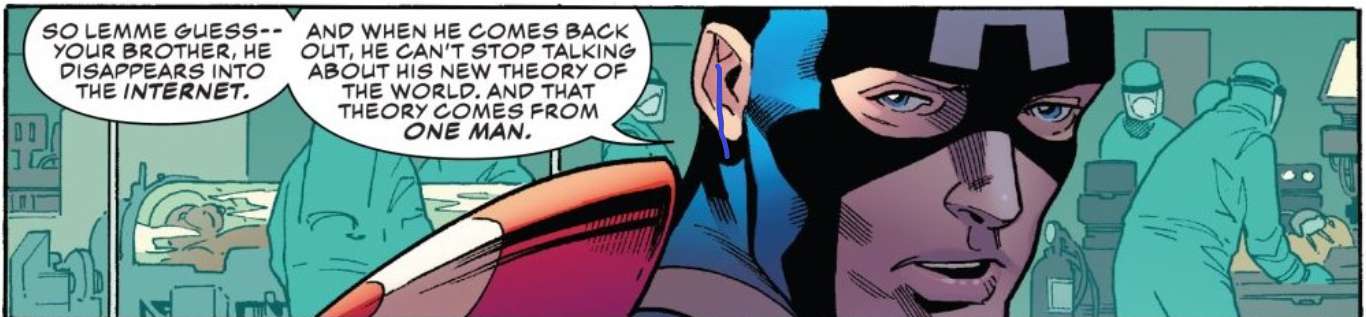
But the fact that the writer picks an obvious target and outright refuses to develop his villainy in any real sense isn't even the worst aspect of this comic. No: that comes at the end, after Cap has stopped Travis and is brought before the government to explain why he destroyed the Liberty Bell in the process:
The lecture Cap delivers here basically encourages these politicians - and the reader - to be suspicious of and confrontational with the guy next door. Our real enemy, Cap says, is our fellow Americans. Other parents cheering in the stands at your local soccer game? They're possible monsters. The mom behind you at the ice cream stand? Don't trust her; she could be a threat. Allow me to be quite blunt: this is evil. This is misusing Cap to gin up further political polarization -- and maybe even foment civil war. And the true Cap would be absolutely appalled.
Suffice it to say that these infinity comics do not represent Marvel’s best. To find those, you should hit the app’s extensive back catalogue — i.e., the reason I signed up for Marvel Unlimited in the first place. At $9.99/month, this subscription is a bargain-basement way to catch up on comics from decades ago. And if you’re willing to wait for three months, you’ll eventually have access to the new comics too.
Saturday, June 19, 2021
One Review, One Advertisement, and Several Streams
Saturday, June 5, 2021
Western Comics, 6/2021
Western Comics: Capsule Reviews
As it turns out, I don’t have much to say about May’s offerings from the Big Two, so this column will focus on three four-star independent graphic novels I read in the past month — one recent release followed by two online recommendations.
T-Bird & Throttle vs. the Moon Men
Writer/Artist: Josh Howard
(How Rad Comics, Superhero)
A YouTube commentator I regularly follow has described this book as the anti-Watchmen, noting that it is a reconstruction (rather than a deconstruction) of the superhero. Said reviewer, in my view, got it exactly right. The first volume of T-Bird & Throttle opens with our protagonist living in disgrace, despised by a world that views men like T-Bird as fascistic, misogynistic, racist — basically any au courant insult you can imagine. But lest you think Josh Howard is simply out to satirize “wokeness,” it should also be noted that T-Bird’s past is not sinless — that, in fact, he does have one major skeleton in his closet for which he needs to atone. So while this story does have some pretty pointed things to say about the eagerness with which certain factions embrace misinformation and smear campaigns, its more important purpose is to tell a redemption story — a purpose it achieves with genuine heart.
Cardboard
Writer/Artist: Doug TenNapel
(Scholastic, Fantasy — Real World Setting, Young Adult)
Are you someone who absolutely adores books like The Velveteen Rabbit or The Miraculous Journey of Edward Tulane? Then this comic might be for you. The premise: an out-of-work widower, struggling to put together some semblance of a decent birthday celebration for his son, meets a weird salesman who sells him an enchanted cardboard box from which figures can be made and brought to life. From this box, father and son build a man who actually turns out to be a great protector and friend — something they end up needing when the neighborhood ne’er-do-well steals some of the magical cardboard and uses it to make a menacing army of monsters. As an adult reader, I was able to predict the progression of the story here fairly easily — and even foresaw the ending. Nonetheless, it still hit me hard in the feels. Why? Because throughout, TenNapel tackles his main characters’ background grief with touching sincerity and real human emotion. The depiction of the father’s difficulties in particular make Cardboard, in my view, an unquestionable winner.
The Shadow Hero
Writer: Gene Luen Yang
Artist: Sonny Liew
(First Second Books, Superhero/Historical)
As I hope I made clear a while back when I reviewed Superman Smashes the Klan, Gene Luen Yang knows how to write. And because he has that talent, he’s able to do “representation” right. He doesn’t lecture the reader, and he doesn’t stack the deck in favor of his specific view of the world. Instead, he channels his experiences as a Chinese American into stories that are creative, complex, and honest — stories like The Shadow Hero, in which Yang unearths a little-known Golden Age hero and gives him an interesting (and tragic) origin story rooted in the mid-20th-century Asian immigrant experience. The only complaint I have here? I would’ve liked to have seen just a little more acknowledgement of the father’s decency and bravery. That he asked the turtle spirit to keep him sober instantly inspires my fascination and sympathy — and puts the lie to the idea that he was a coward. But that bit of quibbling aside, this is an essential read for anyone looking for high-quality “diverse” titles that aren’t just thinly-disguised political tracts.
Yes, I take requests and suggestions! If there’s a particular review you’d like to see, please contact me at hobsonphile@gmail.com and tell me the title, creators, and - most importantly - point of sale. Assuming the comic in question is available for immediate purchase, I will respond in the following issue!
Saturday, May 15, 2021
ICYMI: My Latest Comics Stream w/#1 Marmaduke Fan
Here, we talk about the incredibly stupid marketing campaign for the Hellfire Gala, dive deep into Way of X #1, and then finish the broadcast with my favorite title: Iron Man!
Saturday, May 1, 2021
Western Comics, 5/2021
Western Comics: Capsule Reviews
Marvel
Captain America #28
Writer: Ta-Nehisi Coates
Artist: Leonard Kirk
This comic quickly became infamous on social media for its gratuitous - and not at all disguised - swipe at one of the writer’s prominent philosophical opponents, but I’m not going to use this space to comment on that bit of controversy (other than to state the obvious: it was bad writing). Instead, I’m going to focus on what this comic gets wrong when it comes to the personality and motivations of Steve Rogers. As I wrote in a longer blog post on this particular issue, Steve didn't embrace service to his country because he was weak and lacking in purpose. His desire to enlist was a function of his greatest strength: his steadfast morality. Yes, he was shrimpy before the serum. But he's Captain America because he recognized evil and cruelty in the world and desperately wanted to confront it head on — not because he was some pathetic character seeking to fill a spiritual hole. Furthermore, the premise that Steve would be fundamentally humiliated if he were rescued by a woman completely ignores the female Avengers under whose leadership he’s happily served — and the multiple times they’ve saved his bacon without prompting Steve’s objection. In other words: the villains’ plan here is dumb. Indeed, it diminishes said villains and Steve to reduce the former to disgruntled vloggers. Even beyond the ridiculous caricature of Jordan Peterson, this book is definitely not one I would recommend. ★
Way of X #1
Writer: Simon Spurrier
Artist: Bob Quinn
The most recent crop of X-Men books are, to put it mildly, polarizing. In one camp, we have the intrigued: comic book fans who generally trust the overall creative vision of Jonathan Hickman and expect this different take on mutantkind to lead to some sort of revelation that will ultimately redeem their current behavior. In the other, we have the angry: fans who believe their lifelong favorites have now become supremacist villains for no discernible, salutary reason. To be honest with you, I lean more toward the second position than the first — which is why the 40-page first issue of Way of X caught me so completely by surprise. I picked it up to see how exactly Marvel was planning to screw up Nightcrawler and, in particular, his established Catholic Christian faith. I put it down feeling hopeful (maybe foolishly) that someone at the leading, oh-so-frequently-misguided American comic book publisher actually has some brains — and a chest to match.
Which is not to say that this book is perfect. There are times when Kurt’s dialogue doesn’t quite sound like Kurt. At one point, for example, he states that he “can see no moral flaw” in how the mutants of Krakoa are currently behaving, which certainly doesn’t line up with the explicit horror he displays while witnessing his fellows’ casual disregard for the sanctity of life. As I wrote in the comments of one YouTube review, I think this line should’ve been “I can articulate no moral flaw” rather than “I can see no moral flaw.” I can buy that Kurt is having trouble reconciling his religious traditions - and their associated moral instincts - with the fact of effective mutant immortality. But he quite obviously does see - and is just as clearly bothered - that killing mutants in gladiatorial arenas so that they may theoretically be resurrected with all their powers intact has made many mutants careless and cruel.
Still, it is so, so promising that this comic actually acknowledges the darkness beneath the surface of Krakoan society. This is only the first chapter of this story, so there is still time to utterly flub the landing. But for me, this opening did what no X book has done for years: earned a digital subscription. ★★★1/2
DC
Superman #30
Writer: Phillip K. Johnson
Artists: Sami Basri & Scott Godlewski
It’s only been a couple months, but I’ve been liking Johnson’s work on the Superman titles so far. He’s shown signs that he does understand the true source of Superman’s heroism. Even more importantly, he’s addressing the relationship between Clark and Jon in a very earnest, very heartfelt manner. As some readers of Tightbeam may know, when Jon was aged up (via time/dimensional travel shenanigans), many fans of Superman who enjoyed the dynamics of the Kent family were upset. Well, in issue 30 in particular, Johnson wisely acknowledges those reader complaints in the narrative itself, allowing Clark to express regret that he missed an enormous chunk of his son’s boyhood. If Johnson can continue dipping into this well of genuine human emotion, I think what will result is a fine-to-great run. ★★★1/2
Batman: Urban Legends
(Anthology)
And speaking of genuine human emotion: I can’t recommend the above anthology as a whole. Most of the stories are, for me, eminently forgettable. But if you have the money to spare, you may want to pick this up just for Chip Zdarsky’s Red Hood story, which explores Jason Todd’s troubled past - and his equally strained relationship with Batman - as he tries to do the right thing for a boy he’s quite possibly orphaned through his own rash (though understandable) actions. Said story really is a master class in establishing character motivation - specifically, in driving Jason Todd to murder despite his promise to Batman that he would refrain from killing - and, like Three Jokers (which I reviewed in this column a while back), really tries to get at the core of Todd’s trauma. I only wish Zdarsky had been given his own book!
For the anthology: ★★1/2; for Zdarsky’s story alone: ★★★★
Independent/Crowdfunded Comics
The Underfoot, vol. 2
Writers: Ben Fisher & Emily Whitten
Artist: Michelle Nguyen
(Caracal, Fantasy, Young Adult)
The protagonists of this terrific - and sadly underrated - series are intelligent hamsters — descendants of uplifted lab animals who survived some as-of-now mysterious environmental cataclysm that resulted in the disappearance of their former (presumably human) masters. In this volume, we are introduced to a lizard antagonist who deeply resents that his kind were left behind when the mammals escaped their cages and is therefore determined to visit revenge upon the “furs” once and for all. It's a basic plot — but nonetheless well-crafted. The writers elegantly solve the world-building vs. satisfying progression problem by adding explanatory notes between “chapters,” thereby allowing the story itself to move at a brisk, enjoyable pace. And as with the first volume, the characters are all distinct and lovingly rendered. I definitely recommend this series to any fan of the Redwall or Green Ember books. I myself am eager to pick up volume 3! ★★★1/2
Soulfinder: Black Tide (Book 2)
Writer: Douglas Ernst
Artist: Matthew Weldon
(Iconic Comics, Christian Fantasy)
This series stars a Catholic priest, exorcist, and combat veteran who’s learned he’s especially suited to fight the demonic. Ernst is a very new writer, but he knows how to pick good artists to complement his work. Further, I think his writing reaps the benefits of his real-world experience, his Catholic tradition, and his additional reading in history and philosophy. Impressively, he manages to invent an entirely plausible (but still fictional) saint story to round out the background for the relic that drives the plot for the current volume. And I have always appreciated that the protagonist's abilities here are rooted in his acquaintance with suffering. It’s a solid showing, to say the least — one that manages to convey a religious worldview without necessarily putting off readers with more secular mindsets. Ernst is coming from a clear perspective, but he focuses first on his storytelling and doesn’t preach. ★★★1/2
Reader Requests/Suggestions
Batman: Shadow of the Bat
The Last Arkham
Writer: Alan Grant
Artist: Norm Breyfogle
One of my regular correspondents found the first issue of this story in a bargain bin at his local shop, and on his recommendation, I immediately decided to check out the entire story for myself. The premise? There’s a serial killer on the loose in Gotham whose MO quite closely resembles that of a criminal who’s presumed to be locked up in Arkham Asylum. Suspecting that said criminal has found an escape route within the asylum’s walls, Batman arranges to be imprisoned there — and is immediately abused and tormented by Arkham’s newest lead psychiatrist. What I like about this several issue arc is that it shows there is more than one way to be a villain. On one side, you have the maniac who cuts tally marks into his skin for every murder he perpetrates. On the other, you have Dr. Jeremiah Arkham, who exudes a coldly intellectual, calculating evil that is driven by totalizing ideology rather than a pure lust for mayhem. Speaking for myself, I found the latter a more frightening foe. His absolute certainty that he can modify anyone’s anti-social behavior is creepy in the extreme — as is his (eerily familiar) conviction that the past is worthless and ripe for erasure. If you pick this up, be sure to look out for the B. F. Skinner easter egg! ★★★1/2
Yes, I take requests and suggestions! If there’s a particular review you’d like to see, please contact me at hobsonphile@gmail.com and tell me the title, creators, and - most importantly - point of sale. Assuming the comic in question is available for immediate purchase, I will respond in the following issue!
Saturday, April 17, 2021
From Last Year: Politics in Comics
I'm sure you've heard this one a million times before: "Comics have always been political. Don't you remember that time Captain America punched Hitler in the face?"
The latest purveyor of this canard is Kurt Busiek, who took to Twitter this week to lecture #Comicsgaters for our supposed failure to understand this fact. But bruh -- as much as I loved your 1998 runs on Iron Man and the Avengers, you're revealing your ignorance about our true position.
No one is actually saying comics should be completely apolitical. First of all, that's impossible. We can't help but inject our worldviews into our creative work. Secondly, that would be boring. The reason why we human beings get exercised over politics is that we're fighting over things that actually matter. And stories? Yes, they need to talk about things that matter -- which means, at times, they need to address politics.
But there are good ways and bad ways to incorporate politics into comics -- and here's where we get to the meat of what #Comicgaters are really saying. When we bitch about Current Year comics being "too political," we are are complaining about the following:
- an excessive reliance on political themes.
- a lack of subtlety in addressing those themes.
- a boring uniformity of perspective.
- the warping of established characters to serve political ends.
An excessive reliance on political themes.
Comics in earlier eras sometimes got political. But most of the time, our heroes battled archetypes -- such as the lowlife thug or the megalomaniac with ambitions to dominate the world. Tony Stark, Light of My Life - just to pick one example - was most often pitted against organized crime, unscrupulous business competitors, and - oh, yes - a dude wielding ten alien rings. And that's when he wasn't battling his own psychological maladies! Indeed, the very best Iron Man comic in history, in my view, is one in which the only villain is Tony's own alcoholism.
Today, however, creators seem hell bent on injecting their political views into everything. As I observe in a video I uploaded to YouTube yesterday (which will be linked here in this Sunday's post), this very tendency is what ruins last week's Rescue 2020. What could've been a fascinating reflection on the feasibility of scientific resurrection is disrupted by annoying, off-topic feminist twaddle. And this is not an isolated case. This kind of storytelling failure can now be found everywhere.
A lack of subtlety in addressing political themes.
Sometimes, earlier comics would be on the nose -- particularly during wartime when the demand for patriotic propaganda was high. But be honest: are those the comics that truly endured? Or are they just looked upon as amusing historical curiosities -- or as convenient examples to deploy when you want to justify your own bad writing?
No: comics that last universalize. The X-Men absolutely were an allegory for the marginalized. But that's the point: they were an allegory. They allowed writers in earlier eras to tackle themes of prejudice and discrimination from a timeless distance. The upside to this approach? Those comics don't have an expiration date. They're always accessible.
Writers these days, on the other hand, seem to have no patience for subterfuge. Instead, they slap you right across the face with their so-called "resistance." Thus, their comics are both dated and extremely parochial. Like the Hitler-punching comics of World War II, they will not be endlessly re-read.
A boring uniformity of perspective.
Yes: the comics industry has always had a leftward lean. But in earlier eras, there was still an observable diversity of thought among writers and artists. Steve Ditko, the Objectivist, was allowed a place at the table. And more recently, so was Chuck Dixon.
In Current Year, meanwhile, the left is doing everything it can to purge the comics industry of even vaguely contrary voices. Hell: regardless of your own views, if you even so much as talk to a known dissenter, you're now a prime target for cancellation. See also: Blake Northcott, who's being stalked right now by a bitchy comic book Karen who imagines herself to be a legitimate political commissar. The result of campaigns like this? A monoculture. If you work at one or more of the major publishers, you can only be out and proud if you're an adherent of the D.I.E. religion and agree that Orange Man Bad.
And the more strict and picayune the enforcement of the aforementioned monoculture becomes, the more radical - and more predictable - the books become. When political topics are addressed, they're almost always addressed in the exact same way -- to the point that we all make jokes now about the ubiquity of the straight, white male villain; the female character who wuvs da science; or the butch, black lesbian.
For Christ's sake, do something else.
The warping of established characters to serve political ends.
It's fair to say that the comics of earlier eras, for the most part, expressed a broadly liberal worldview. But what did that mean exactly?
Well, for one thing, it meant that Captain America went on record defending free speech for bigots:
![]() |
| Click to embiggen. |
It also meant a rejection of retaliatory, supremacist attitudes, as we see here with Machine Man:
The comics of earlier eras were generally pro-Civil Rights, pro-worker, and skeptical of war. Tony Stark - to once again dip into the lore I know the most about - eventually left the weapons business for more idealistic pursuits, was very generous with his employees, and always demanded ethical conduct from his corporate board. But to suggest that you can draw a straight line from this sort of classical progressivism to today's radicals is to pull a fast one. No: SJW writers have more in common with an Iron Man villain like Firebrand - the guy who wanted to start riots and tear down the system - than with the legacy heroes.
And because a bunch of Firebrands are now in charge of the comics sold in the direct market, said legacy heroes? They're being absolutely butchered. The most recent simulacrum of Tony Stark is dead now (sorry about that spoiler), but before his demise, he was leading a terrorist movement. Steve Rogers has been deconstructed and consequently robbed of his agency. She Hulk has apparently become a violent feminist vigilante. The X-Men are now segregationist mutant supremacists. Need I go on?
TL;DR: There's no continuity between early canon and the present. On the contrary, there's been a fundamental rupture.
Conclusion:
To be sure, none of the above commentary is meant to suggest that there are no readable comics coming out of the mainstream industry. There are -- but they're getting increasingly harder to find amongst all the dreck. And yes: we contend this is because comics have become "too political" in all the ways described in this post.
If you're going to argue against this charge, at least take the time to accurately comprehend what we mean.
Saturday, April 10, 2021
Hail Lobster!
Saturday, April 3, 2021
Western Comics, 4/2021
Kamen America, vol. 3
Writer: Mark Pellegrini
Artist: Timothy Lim
(Iconic Comics, Superhero)
The young ladies who make up the Kamen Corps are just as adorable - and layered! - as ever in this, the third entry in the crowdfunded Kamen America series. Once again, Pellegrini and Lim demonstrate that they are consummate pros when it comes to delivering a product that is both entertaining and of high quality. I didn’t feel quite the same emotional punch with this book as I did with volume 2 (see my first column for Tightbeam), but there is still much here to inspire my happy recommendation, including a twist in the final pages that will make you want to read the first three volumes again — and an on-point-yet-subtle commentary on the chaos envy can wreak in many female relationships. PS: My own prediction regarding Carly’s rival turned out to be 100% accurate. Go me! ★★★★
Flying Sparks, vol. 1
Writer: Jon Del Arroz
Artist: Jethro Morales
(Amazon, Superhero)
Yes, I know: I’m incredibly late on this one — and I regret that because the concept that animates this book is a super fun spin on a classic trope. I’ve always been a big fan of what some on the net term “identity porn.” I love, for example, all those scenes in my classic Marvel comics in which some other Avenger openly praises or longs for Tony Stark’s engineering expertise while Iron Man is standing right there. Well, in Flying Sparks, Del Arroz takes the identity porn to a whole new - and delicious - level. You see, in their ordinary lives, Johnny and Chloe are boyfriend and girlfriend — but in their secret lives, they are, respectively, a budding supervillain and a budding superhero. The irony this sets up as we jump between competing narratives definitely makes for an excellent read. ★★★★
Stillwater, vol. 1
Writer: Chip Zdarsky
Artist: Ramon Perez
(Image Comics, Fantasy — Real World Setting)
As you may have noticed, Zdarsky is a writer I trust and like, so when I saw this series up for sale, I didn’t hesitate to pick it up. The eponymous town in this book is one in which, thanks to a mysterious event years ago, no one ever ages and no one ever dies. To protect the secret of Stillwater, the town judge has locked the place down and barred any of its residents from leaving — or communicating with outside friends and family. But not everyone is happy with this state of affairs; some are chafing under the judge’s tyrannical rule and are assembling to challenge his authority so that they may live ordinary lives. It’s an interesting premise - particularly in this day and age - because it highlights the tension that always exists between a population’s security and its liberty. The first issues here haven’t really gotten to the meat of the story just yet, but I absolutely see its potential and will be following this series in the future. ★★★ 1/2
Wrath, #1-2
Writer: Scott Kysh
Artists: Emi Utrera & Drew Smith
(Wikid Publishing, Fantasy — Real World Setting)
The main character of this new crowdfunded comic is a survivor of childhood abuse who learns that his anger at his biological father can escape his body and take physical form in the real world. The story has only just begun, so I don’t know yet where the author intends to take this idea. However, I’m intrigued already that the protagonist does not have perfect control over his spirit monster — and that he seems to get a possibly corrupting rush from using his new ability. This could be a really strong exploration of the negative impacts of unprocessed trauma depending on what happens next. As with Stillwater above, there is potential here, and I’m genuinely eager to buy the next issue. I just hope I don’t have too long to wait! ★★★ 1/2 .
And while you're here, click below to listen to my latest Iron Man-focused stream!
Saturday, March 27, 2021
Handling Racism in Comics
One better-than-average modern example -- and one that is execrably bad.
The "representation" crusade that has taken over the mainstream comic book industry is, in my view, a blundering, incompetent attempt to "fix" a "problem" that wasn't especially pressing (and probably would've resolved itself organically given enough time if publishers continued to hire people on merit). Strong non-majority heroes have existed for decades -- and they've existed in enormously popular books (like the X-Men series) at that. If anything, what today's writers and artists have done is strip said non-majority characters of their dimension by excessively hammering present-day politics and forgetting about the fun. Got a comic featuring a black character? Inevitably, it has to bring up police brutality and Black Lives Matter. Got a comic featuring a Hispanic character? Nine times out of ten, it'll be about illegal immigration. Got a comic featuring a LGBT+ character? Well, is he/she/they even queer if it isn't mentioned in some awkward and ham-fisted way? It's boring and predictable, this relentless no-escapism, and in many cases, it trashes the visions of these characters' original creators, who sought to create inspiring and complex role-models for their diverse audience.
Now, having said all that, I do think it's possible to, every once in a while, write an okay - or even good - comic that tackles a controversial social issue. As a matter of fact, I read just such a book earlier this week: Superman Smashes the Klan, an all-ages graphic novel by Gene Leun Yang and Gurihiru.
The message of Superman Smashes the Klan is not especially subtle -- but unlike most other books in its niche, it avoids Manichaean demonization - or sacralization - of entire subgroups of people in favor of treating its characters as individuals. Roberta, the lead, resents the pressure she feels to assimilate -- but her older brother Tommy is more easy-going and willing to joke about his Chinese heritage, and her father (also eager to fit in) repeatedly demands her mother refrain from speaking her native Cantonese. I strongly suspect the author favors Roberta's point of view -- yet at no point are Tommy and Dr. Lee portrayed as anything but sympathetic. In other words, Yang reveals that Chinese-American views on assimilation are not monolithic, and he does so without unfairly vilifying approaches with which he does not agree.
"But what about Yang's white characters?" you may ask next. Well, they too vary in their beliefs. The clergymen who founded the Unity House are clearly racially progressive, and the white kids who hang out there are also well-meaning (if occasionally insensitive). And then you have Chuck; his family members are mixed up in the activities of the local Klan, but even he is depicted as a confused, misguided boy who fundamentally wants to do the right thing. The upshot? Yes, there are over-the-top Klansmen here, but they are definitely outnumbered by the white characters who are principled, moral, and/or capable of redeeming themselves.
In every way, Superman Smashes the Klan outclasses the recently released Nubia: Real One, another graphic novel targeted to young audiences that attempts to address racism in the US. Yang's work allows for layers and nuance; L.L. McKinney's hateful book, on the other hand, does not.
In Nubia: Real One, every white character is racist and evil -- and every black character is a saintly victim. According to McKinney, white society would largely reject a young black woman with superhuman abilities -- even though, once again, Storm (just to take one example) has been a central X-Man since Claremont (who, by the way, is white -- as was Jack Kirby, who created T'Challa). According to McKinney, BLM-associated riots are the fault of white outside agitators -- even though plenty of real-world cases demonstrate that this is not wholly the truth. According to McKinney, a black girl would obviously be blamed for a convenience store robbery regardless of the surveillance footage or the many witnesses who could provide evidence in her defense -- a contention even black reviewers have challenged as patently ridiculous. According to McKinney, there's nothing a black girl needs to do to develop herself and become a better person -- even though wise people would say that self-improvement is an obligation for every human being.
In short, Nubia: Real One insults the reader's intelligence with flat caricatures and nonsense premises that fail the test of verisimilitude, whereas Superman Smashes the Klan gives us, for the most part, actual human beings. Moreover, while Superman Smashes the Klan is blessed with visually appealing art, Nubia: Real One assaults our eyes with atrocious Tumblr-style drawings that make Diana Prince look like a pug-nosed hag and similarly rob Nubia of her beauty and femininity. No one should be satisfied with such a deliberate destruction of the heroic. The entire point of a superhero comic is to give the reader something to aspire to -- not to wallow in the base and prosaic.
As long as comics like Nubia: Real One continue to be churned out by open racists and segregationists, people will continue to chafe at the idea that we should talk about race in our comic books. It's an infinitely better choice to produce books like Superman Smashes the Klan. It's an infinitely better choice to hire people with actual talent and hold everyone to the same exacting editorial standards.
Edited to add a related video:
Yeah, I imagine that is how they be. No-escapism infests all media.